RELEASE
RELEASE | September 2026
Möbius Quantum Computation: A New Topological Resource for Quantum Error
Cancellation
The Möbius Quantum Computation (MQC) Research Programme, French-Argentinian Collaboration, conducted by José
Luis Mac Loughlin and Norma G. Sanchez shows how twisted boundary conditions
can globally and geometrically cancel coherent quantum errors, a crucial problem in today quantum computation.
|
|
|
José
Luis Mac Loughlin¹ |
|
¹ School of Arts and Sciences,
Museum House and Quantum Laboratory, La Plata city 1900, Provincia de Buenos
Aires, Argentina |
|
Norma
G. Sanchez² |
|
²
International School and Institute of Astro-Physics
Daniel Chalonge-Hector de Vega, CNRS, INSU-Institut National des Sciences de
l’Univers, Sorbonne Université, 75014 Paris, France |
|
Contact: chalonge.ecoleATchalonge-devega.fr |
https://chalonge-devega.fr |
A
new theoretical study proposes that Möbius boundary topology can serve as a
passive resource for suppressing coherent errors in quantum computation. This
is a crucial item for quantum computation today. The paper A New Topological Resource for
Quantum Error Cancellation is the second study of the Möbius Quantum
Computation (MQC) research programme.
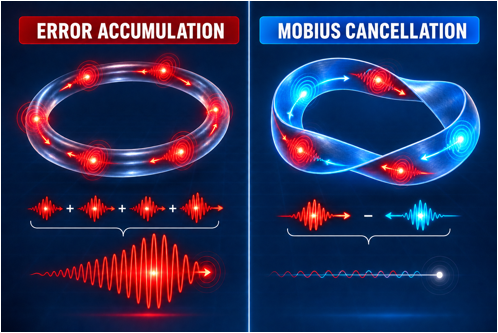
Quantum processors are affected not
only by random decoherence but also by coherent and systematic errors, such as
phase drifts, imperfect calibrations, repeated over-rotations and slowly
varying control errors. Because these perturbations can accumulate
constructively over many operations, they can become especially damaging in
long quantum circuits.
The new proposed
mechanism replaces an ordinary closed-chain return condition with an effective Möbius
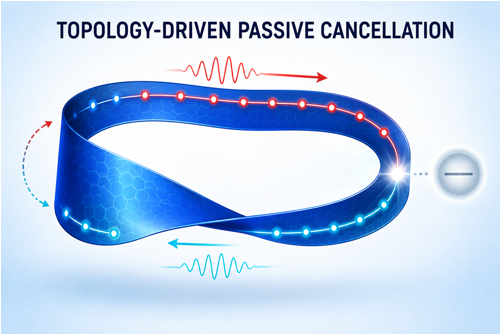
identification. After one complete traversal, a quantum
amplitude is compared with a twisted copy of itself. For symmetric coherent
perturbations, the phase accumulated along one branch is opposed by its
topologically reflected contribution, producing geometric cancellation.
Unlike
conventional quantum error correction, the cancellation does not rely on
redundant logical encoding, syndrome measurements or active recovery. It is
boundary-driven, topology-driven and passive. The approach is therefore presented
as a efficient complement to established error-mitigation and fault-tolerant
architectures, not necessarily a replacement for them. And it is a
much more economical and sustainable resource, with less consumption.
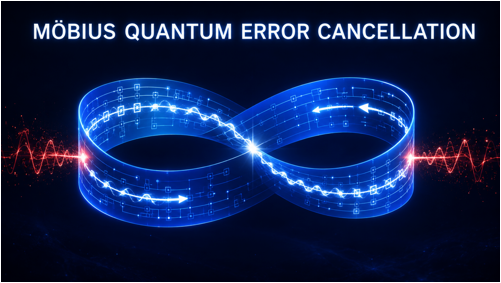
Passive Error
Cancellation: By mapping information
qubits onto a non-orientable Möbius topology, quantum states undergo a logical
inversion upon completing a computational cycle. This generates a
"topological echo" effect that naturally cancels first-order coherent
errors, without the need for cumbersome error-correction codes.
The study
also identifies it
limit of the proposal: imperfect symmetry leaves a residual error governed by
the mismatch between the ordinary and twisted branches. The mechanism is
expected to be most relevant to slowly varying, systematic and spatially
correlated coherent errors; it is not intended to cancel arbitrary local
stochastic noise.
Possible
future implementations include photonic waveguide arrays, superconducting circuits with
synthetic boundary conditions, cold atoms, trapped-ion systems and quantum
materials. The essential requirement is not a literal Möbius strip, but an
effective non-orientable boundary rule engineered in the quantum dynamics.
KEY POINTS
·
A global Möbius boundary condition converts accumulated coherent phase
error into a difference between two topologically related branches.
·
For symmetric coherent perturbations, the leading phase contributions
cancel after one complete traversal.
·
The mechanism is passive and uses no measurement, nor redundancy nor
active recovery operation.
·
The work is a proof of principle and motivates numerical, circuit-level
and experimental tests.
IMPACT
· Topology can make quantum errors cancel themselves
· A Möbius twist becomes an operational resource
for quantum control.
· Passive error suppression could work before or alongside active quantum
error correction.
· From mathematical non-orientability to experimentally engineerable
quantum boundary rules.
· WHY THIS RESULT MATTERS
NOW
Quantum error control is one of the decisive
obstacles to useful large-scale quantum computing. The present result
introduces a different design principle: instead of correcting every coherent
error only after it appears, quantum dynamics may be engineered so that a
specific class of errors cancels through the global boundary topology itself. Implemented
in realistic devices, this passive layer could reduce the burden placed on
active correction and strengthen hybrid fault-tolerant strategies.
SUMMARY
|
This Paper II of the Möbius Quantum
Computation programme proposes a new passive
mechanism for cancelling coherent quantum errors. A twisted Möbius boundary
makes topologically related phase contributions and opposes one to another,
which global result is their cancellation. The theoretical proof of this principle
can inspire complementary protection layers for photonic, superconducting,
atomic and other quantum platforms. |
THE MQC RESEARCH
PROGRAMME
The Paper I
introduced Möbius topology as a boundary framework for quantum information
processing. This Paper II develops one concrete physical consequence of that
framework: the passive coherent-error cancellation. Future work will examine
topological gate implementations, algorithms and platform-specific
realizations.
The
central result :
For symmetric
coherent perturbations, the leading accumulated phase error cancels after a
complete traversal under the Möbius boundary identification.
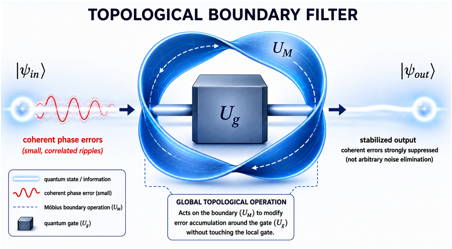
Möbius
boundary condition acting as a global topological filter
around a local quantum gate  . The boundary operation
  modifies
the accumulation of small, correlated coherent phase errors without altering
the gate itself, producing a stabilized output with strongly suppressed
coherent errors. The mechanism is complementary to conventional quantum error
correction and it appears as an economical and sustainable resource for quantum
computation.
modifies
the accumulation of small, correlated coherent phase errors without altering
the gate itself, producing a stabilized output with strongly suppressed
coherent errors. The mechanism is complementary to conventional quantum error
correction and it appears as an economical and sustainable resource for quantum
computation.
This mechanism
acts as a complementary quantum error correction
It is designed as a passive complementary layer for particular coherent
errors, potentially operating before or alongside active fault-tolerant
methods.
The key requirement is an effective non-orientable boundary
identification encoded in the quantum dynamics.
What
comes next?
Numerical robustness studies, circuit mappings and platform-specific
experimental demonstrations.
PAPER AND AUTHORS INFORMATION
|
Paper: “Möbius
Quantum Computation: A New Topological Resource for Quantum Error
Cancellation” |
|
Authors: José Luis Mac Loughlin¹ and Norma G. Sanchez² |
|
¹ Founder
and Director of the School of Arts and Sciences, Museum House and Quantum
Laboratory, La Plata city 1900, Provincia de Buenos Aires, Argentina. ² Founder and Director of the
International School and Institute of Astro-Physics Daniel Chalonge-Hector de
Vega, Research Director at CNRS, INSU-Institut
National des Sciences de l’Univers, Sorbonne
Université, Paris, France. Contact: chalonge.ecoleATchalonge-devega.fr | https://chalonge-devega.fr |
https://www.researchgate.net/publication/414594572_MOBIUS_QUANTUM_COMPUTATION_A_NEW_TOPOLOGICAL_RESOURCE_FOR_QUANTUM_ERROR_CANCELLATION
https://chalonge-devega.fr/Mobius_Quantum_Error_Cancellation.pdf