
José Luis Mac Loughlin 1 Norma G. Sanchez 2
1School of Arts and Sciences, Museum House and Quantum Laboratory, La Plata city 1900, Provincia de Buenos Aires, Argentina
2 International School and Institute of Astro-Physics Daniel Chalonge- Hector de Vega, CNRS, INSU-Institut National des Sciences de l’Univers, Sorbonne Université, 75014 Paris, France.
Contact : chalonge.ecoleATchalonge-devega.fr,
Keywords : Quantum Computing • Quantum Information • Möbius Strip • Topology • Geometric Quantum Evolution • Topological Boundary Conditions • Quantum Gates • Quantum Technologies
Quantum computing has the potential to revolutionize information processing by exploiting the principles of quantum mechanics. Yet major challenges remain, including maintaining quantum coherence, controlling quantum states, and reducing computational errors.
A new theoretical study by José Luis Mac Loughlin and Norma G. Sanchez proposes an original approach inspired by one of the most fascinating objects in mathematics: the Möbius strip.
Their work, “Möbius Quantum Computation: A New Topological Boundary Framework for Quantum Information Processing,” introduces a new conceptual framework in which the global topology of a Möbius geometry becomes an active element in quantum computation rather than simply a mathematical illustration.
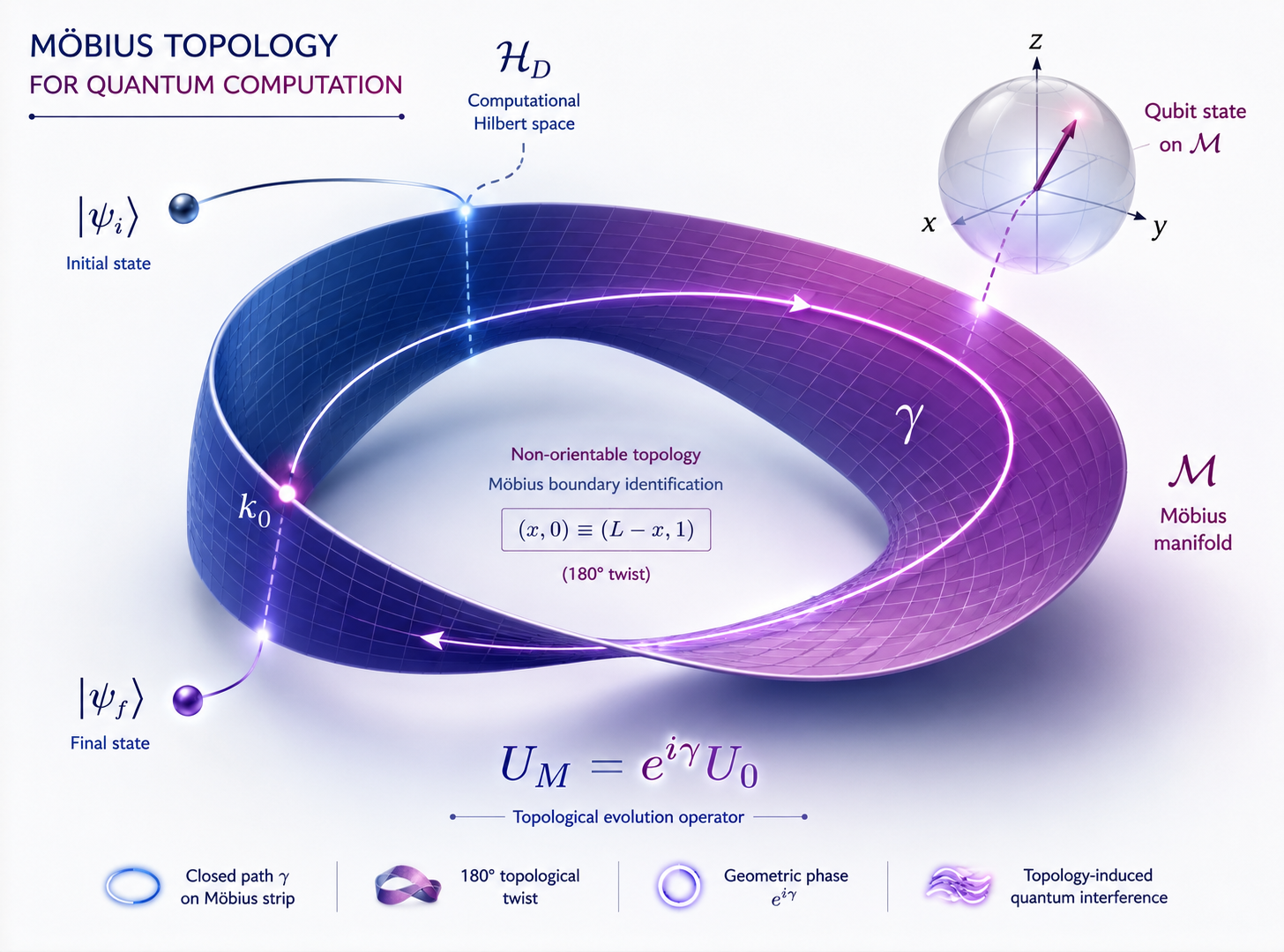
Graphical abstract: Quantum evolution on a Möbius manifold. A initial quantum state evolves along a closed path g on the Möbius geometry and returns to a final state f after a single complete path. The non global orientability produces an additional topological -geometrical phase in the evolution operator. The Bloch sphere illustrates the state space of a qubit.
The Möbius strip is remarkable because it possesses one continuous side and one continuous boundary which changes orientation and topology. This unusual global structure has fascinated mathematicians and physicists for more than a century.
In the new study, the authors explore how Möbius non-orientable boundary conditions influence quantum evolution and inspire new architectures for Quantum Information Processing and a Topological way of Quantum Error Cancellation.
The paper proposes treating Möbius topology as a computational resources, in particular quantum error cancellation, suggesting novel mechanisms for implementing quantum operations and designing future quantum processors.
There are several ongoing topological quantum research directions, but this paper introduces a distinct viewpoint centered on Möbius topology and its contribution to quantum information processing.
The authors identify several promising research directions arising from this proposal, including:
Application to quantum error mitigation and fault tolerance.
Extensions to other non-orientable topological structures.
New connections between topology, geometry, and quantum information science.
The work also yields an informational vision of vacuum physics linking to global vacuum effects emerging in several contexts from the quantum laboratory to gravitational physics.
Interestingly enough, from this global (topological) perspective, the quantum computer with Möbius boundary conditions can be viewed as a controlled informational analogue of a quantum vacuum with global topological constraints.
This study represents the beginning of a broader research program devoted to understanding how geometry and topology can become active ingredients in conceptual quantum technologies rather than passive mathematical framework.
The Möbius Quantum Computation framework proposed here offers one such perspective by combining concepts from topology, geometry, and quantum physics into a unified proposal.
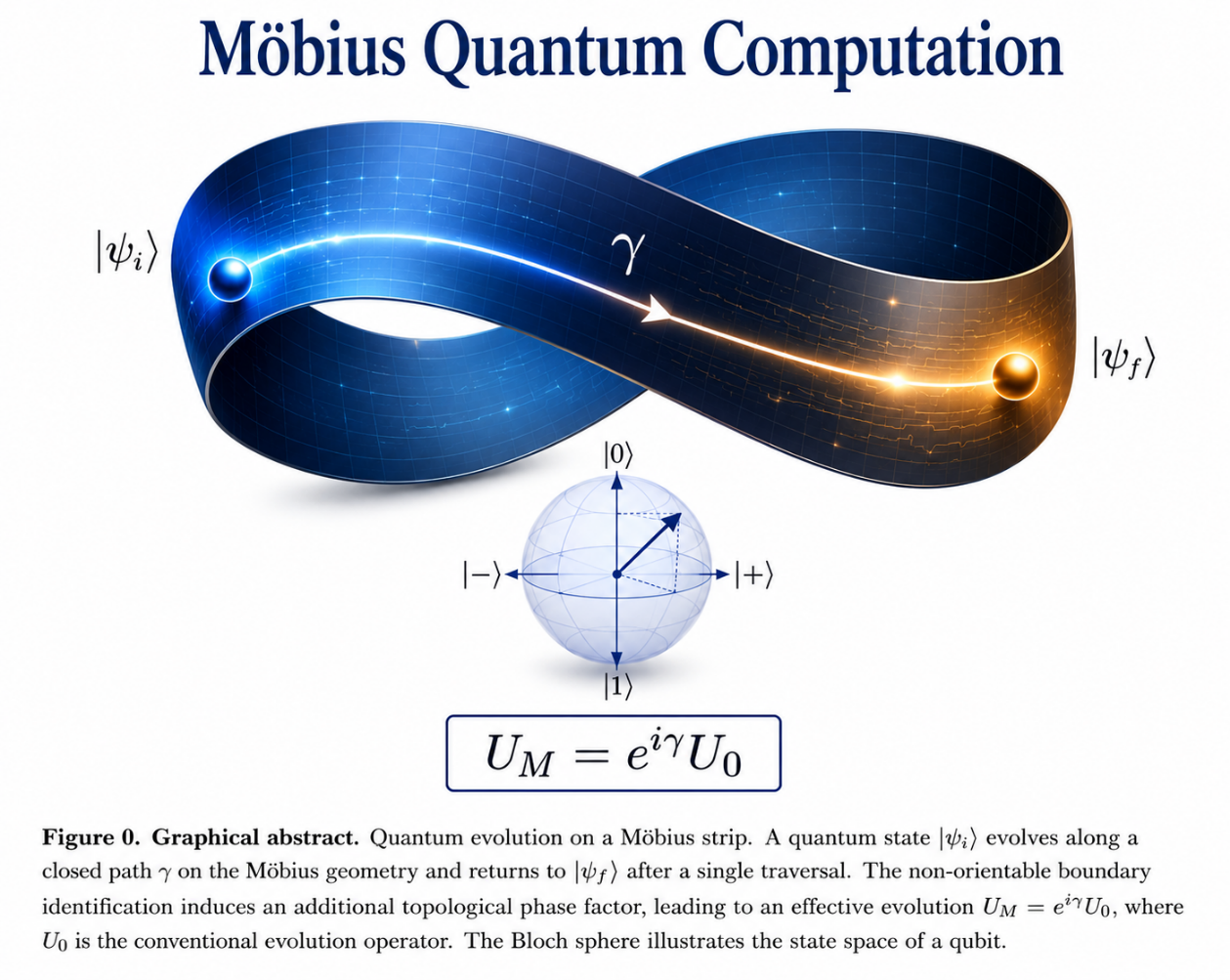
Article
Möbius Quantum Computation: A New Topological Boundary Framework for Quantum Information Processing
Authors and Affiliations:
José Luis Mac Loughlin 1, Norma G. Sanchez 2
1School
of Arts and Sciences, Museum House and Quantum Laboratory, La Plata
City 1900, Provincia de Buenos Aires, Argentina
2 International School and Institute of Astro-Physics Daniel Chalonge- Hector de Vega, CNRS, INSU-Institut National des Sciences de l’Univers, Sorbonne Université, 75014 Paris, France.
Reference and links : Researchgate Publication, DOI: 10.13140/RG.2.2.33458.36806 (July 2026)
https://chalonge-devega.fr/Mobius_Topology_Quantum_Computation.pdf
Contact : chalonge.ecoleATchalonge-devega.fr,
--